6 SMS Lead Follow Up Templates and 60 Second Ack for Small Businesses
Practical SMS playbook for small businesses: send an automated acknowledgment within 60 seconds, use six ready templates, and run a 5 to 7 message cadence...
How many customers are slipping away before you can answer?
Answer 4 quick questions and get a simple missed-call estimate for your business.
Answer with one tap. Contact details come after your result.
Here is the estimate.
Thanks. Your result was received.
Yes, SMS follow-up converts, but only when you respond fast and give the lead one clear next step. The single best action you can take right now is to send an automated acknowledgment within 60 seconds of a lead coming in, paired with a booking link for med spa SEO growth or a one-question qualifier. Everything else in your follow-up process builds on that first message.
TL;DR:
- Sending an automated acknowledgment within 60 seconds of lead arrival significantly increases the chance of engagement and should always include a booking link or qualifier.
- Follow-up sequences should last 14 to 21 days with five to seven messages for most leads, but shorter, 2 to 4 message sequences are more effective for abandoned bookings within 48 hours.
- Keep follow-up texts concise, personalized, and focused on a single clear next step, avoiding marketing language and multiple calls to action to improve response rates.
- Automating triggers such as form submissions, missed calls, or opt-outs, with built-in exit criteria, prevents over-messaging and ensures compliance with opt-out laws.
- Most small businesses wrongly treat SMS like email; the real value lies in the channel’s immediacy and the discipline of short, timely, value-driven messages.
Table of Contents
- Why SMS Works for SMS Lead Follow Up
- How Often Should You Follow Up by Text?
- SMS Templates for Every Stage of Lead Follow Up
- What Makes a Follow-Up Text Actually Convert
- Building an Automated SMS Follow-Up Workflow
- Compliance Rules You Can't Skip
- How RingPort Runs This Same Workflow
- What Most Small Businesses Get Wrong About Text Follow-Up
- Automate Your Follow-Up Without Hiring Another Rep
- Sources
- FAQ
Why SMS Works for SMS Lead Follow Up
Speed decides more of this outcome than clever copy ever will. A lead who fills out a form or calls your business is thinking about their problem right then, and that window of intent closes fast. Text them back inside a few minutes and you're still part of the conversation they started. Wait until tomorrow and you're competing with three other businesses who called back first.
That's also why immediate acknowledgment texts work so well: they validate that the lead reached a real business and give them a quick way to confirm details, without waiting on a phone call. This single touch often does more for speed to lead than any script that comes after it.
SMS has a structural advantage over email for this job, too. People check texts almost reflexively, and a short message with one clear ask doesn't compete with an inbox full of newsletters. That makes SMS the right channel for four specific jobs: acknowledging a new lead, running a quick qualifying question, sending a booking link, and reminding someone about an upcoming appointment.
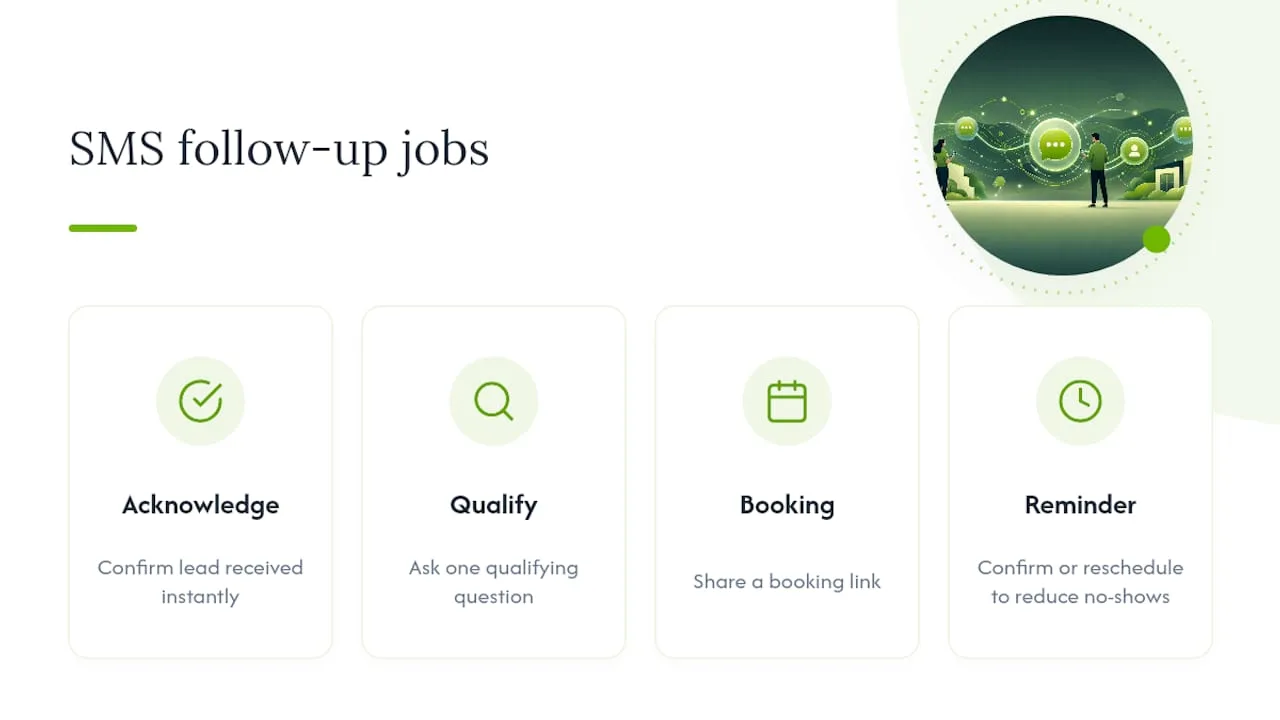
Pro Tip: SMS is also unusually effective for appointment confirmations paired with an easy confirm or reschedule flow, which cuts down on no-shows without adding staff time.
How Often Should You Follow Up by Text?
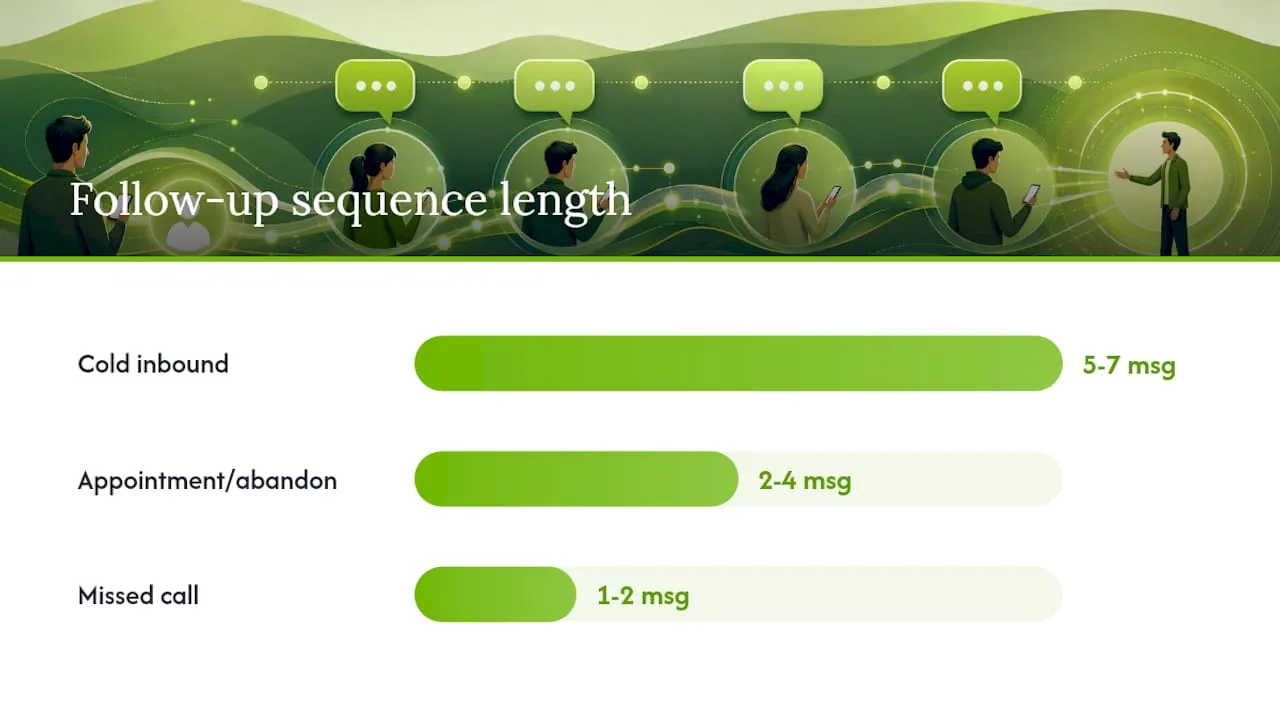
A workable text sequence isn't a single message, it's a short campaign with a clear end date. Most effective SMS marketing follow up programs run 5 to 7 messages over 14 to 21 days, with defined exit criteria so the sequence stops the moment it's done its job, whether that's a booking, an opt-out, or hitting the message cap.
A cadence that holds up for most local service leads looks like this:
- 0 to 60 seconds: automated acknowledgment confirming the inquiry was received.
- 30 to 90 seconds: a phone call attempt, if your workflow includes live outreach.
- Day 1: a short check-in text asking if they still need help.
- Day 3: a value-add message, maybe answering a common question or sharing a quick win.
- Day 7: a low-pressure "breakup" text that often gets more replies than the polite check-ins before it.
Appointments and abandoned bookings need a tighter version of this. If someone started scheduling but didn't finish, run a condensed 2 to 4 message sequence inside 48 hours rather than stretching it over three weeks. Intent is higher and decays faster.
| Lead type | Sequence length | Timeframe |
|---|---|---|
| Cold inbound lead | 5 to 7 messages | 14 to 21 days |
| Appointment or abandoned booking | 2 to 4 messages | 48 hours |
| Missed call callback | 1 to 2 messages | Within 5 minutes |
SMS Templates for Every Stage of Lead Follow Up
Ready-to-send copy saves you from writing under pressure every time a lead comes in. Each template below uses bracketed tokens, like [Name] or [Service], that your CRM or texting tool should fill automatically. If a field is missing, default to a generic but still personal fallback ("there" instead of a first name, "your project" instead of a specific service).
- New lead acknowledgment (send within 60 seconds). "Hi [Name], this is [Business] — got your request for [Service]. Can you reply with a good time to call, or [book here] [link]?"
- Missed call text back (send within 5 minutes). "Sorry we missed your call! This is [Business]. What can we help with? Reply here or text STOP to opt out."
- Day 1 no-response follow-up. "Hi [Name], following up on [Service] — still looking for help with this?"
- Booking link nudge (Day 3). "Quick one, [Name] — want to grab a time that works for you? [Link] takes about 30 seconds."
- Reschedule request. "Hi [Name], looks like your appointment on [Date] might need to move. Reply with a better day or use [link]."
- Breakup message (Day 7). "Haven't heard back, [Name], so I'll close this out for now. Text anytime if [Service] comes back up — happy to help."
Pro Tip: The breakup text isn't a goodbye, it's a re-engagement lever. Leads who go silent for a week often reply to this exact message because it removes the pressure of feeling chased.
What Makes a Follow-Up Text Actually Convert
Short wins over clever, every time. Keep messages to one or two sentences, and give the reader exactly one thing to do. A text with two calls to action just gives them permission to do neither.
- Use the lead's first name and one specific detail from their inquiry, not generic filler.
- Ask a single micro-qualifying question ("Morning or afternoon work better?") instead of a full intake form disguised as a text.
- Skip marketing language entirely, phrases like "limited time" or "act fast" read as spam on a personal channel.
- Match the lead's own tone and channel; if they texted first, don't suddenly switch to a phone call as your only reply option.
- Lead with the next step, not a recap of who you are, they already know that from the first message.
Value-first messages with a clear next step consistently outperform generic promotional texts, and that gap only widens the longer a sequence runs.
Building an Automated SMS Follow-Up Workflow
A workflow is only as good as its triggers and its off ramps. Build both before you build the message copy.
Common triggers worth automating:
- Form submission on your website or landing page.
- A missed inbound call.
- An inbound keyword reply, like "STOP," "INFO," or "YES."
- An abandoned appointment booking attempt.
Exit criteria matter just as much as the triggers, and skipping them is how businesses end up over-messaging leads who already converted. Program checks for conversion, opt-out, disqualified status, and a hard cap on message count before every single send, not just at the start of the sequence.
- The lead booked or converted, stop all further messages.
- The lead replied STOP or any opt-out keyword.
- The lead has been marked unqualified in your CRM.
- The sequence hit its max message count.
When a reply needs a human, hand it off with the full conversation history attached so your team isn't asking the lead to repeat themselves. That single detail is often what separates a smooth handoff from a lead who feels like they're starting over.
Compliance Rules You Can't Skip
Get consent documented before you send anything beyond a transactional acknowledgment, and keep that record somewhere your team can pull up if a lead disputes it later. Honor opt-outs the moment they arrive, and suppress that contact across every channel, not just SMS. Stick to reasonable daytime sending windows.
- Document consent at the point of lead capture.
- Process STOP replies immediately and sync suppression lists across SMS, email, and voice.
- Send only during reasonable hours, generally daytime, to protect deliverability and reduce complaint risk.
- Keep an audit log of consent and opt-out events for at least as long as your state or carrier guidelines require.
Skipping any of these isn't just a legal risk, it's also how you get flagged by carriers and lose deliverability for every future message.
How RingPort Runs This Same Workflow
RingPort was built around this exact sequence, because it's the same problem local service businesses call about constantly: missed calls, slow replies, and leads who go cold before anyone follows up. A typical setup looks like an instant SMS acknowledgment the moment a call or form comes in, a booking link inside that first text, a Day 1 check-in if nothing's booked yet, and a handoff to a real person the moment the conversation needs judgment a bot can't provide.
The feature set maps directly onto the checklist above:
- 24/7 automated acknowledgment, so no lead waits past business hours.
- Smart call routing that hands off complex conversations to a real team member.
- CRM sync that updates lead status automatically as replies come in.
- Built-in message suppression so opted-out or converted leads stop receiving texts.
What Most Small Businesses Get Wrong About Text Follow-Up
Most advice on this topic treats SMS like a slightly faster email, and that's the mistake. The value isn't the channel, it's the compression it forces on you. A text that takes ten seconds to read has to earn its reply in one sentence, and that constraint is exactly what most small business follow-up sequences lack. Owners write texts the way they write emails, three sentences of context before the ask, and wonder why response rates sit lower than they should.
The other overrated piece is sequence length. Plenty of guides push for longer nurture campaigns as if persistence alone converts leads. In practice, a well-timed breakup message on Day 7 does more work than five more check-ins would, because it removes pressure instead of adding it.
If you're setting this up for the first time, don't start with templates. Start with the exit criteria, because a sequence that doesn't know when to stop is the fastest way to burn trust with a lead who already said no. Get the ack speed and the off ramps right first. The wording is the easy part.
— Serhii
Automate Your Follow-Up Without Hiring Another Rep
An AI receptionist platform is a practical way to run everything covered above without staffing a dedicated follow-up person around the clock. It sends the instant acknowledgment the moment a lead calls or fills out a form, works the Day 1 and Day 3 touches automatically, and hands the conversation to a real team member the second a lead needs more than a scripted reply.
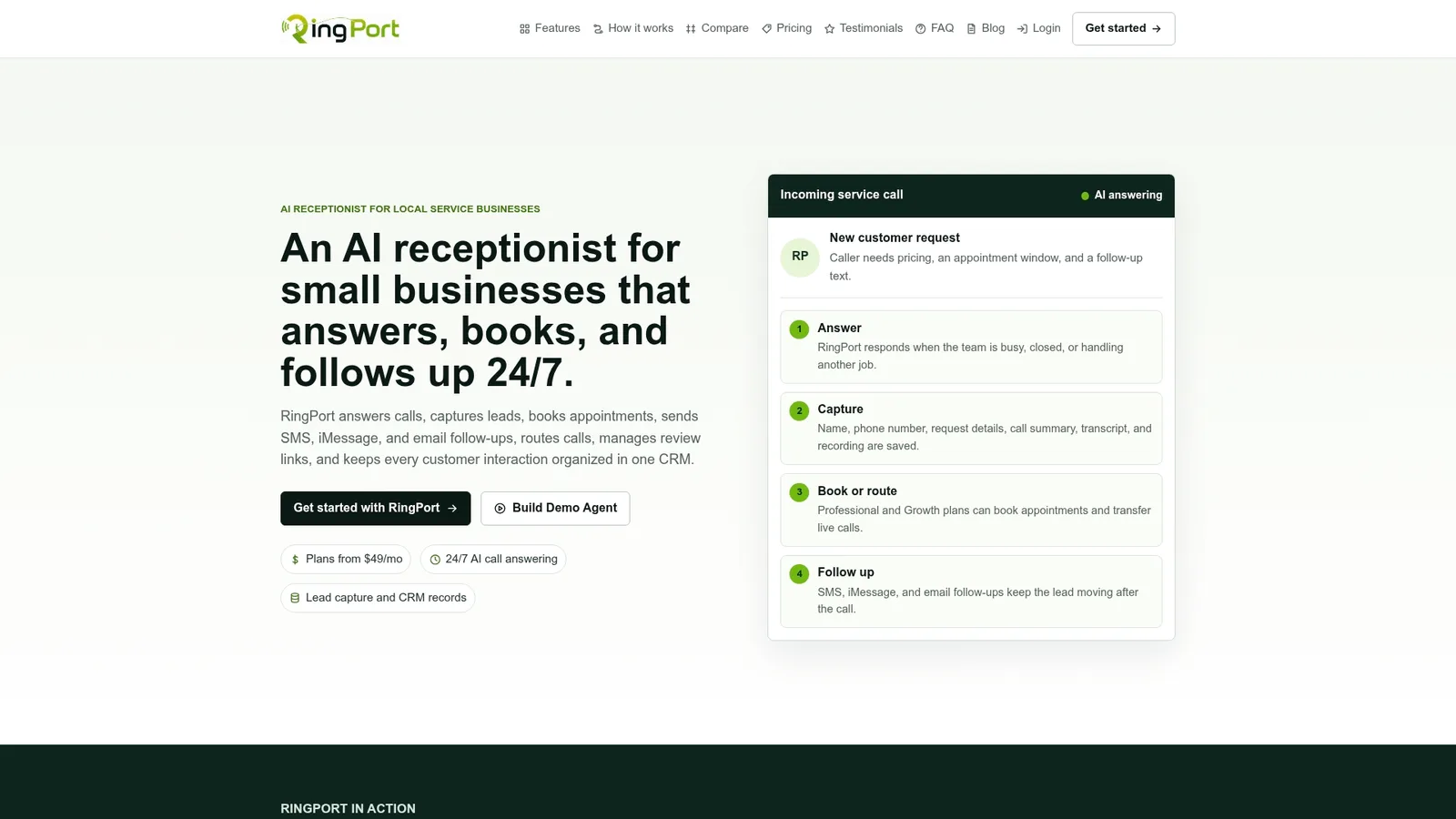
If you're currently relying on a team member to text leads back between other tasks, that's the gap RingPort closes. The RingPort Fast Agent is built specifically for getting that first acknowledgment and follow-up sequence running fast, without weeks of setup. Check out the full RingPort platform to see how call answering, SMS follow-up, and CRM updates work together, and start a trial to see your own speed-to-lead numbers change within the first week.
Sources
For deeper reading on compliance and cadence, see Sinch's guide to SMS drip campaigns, TextMagic's lead nurturing strategies, and LeadGen Economy's compliance guide.
- A guide to setting up Salesforce SMS drip campaigns - Sinch
- SMS Marketing for Lead Nurturing: Compliance Guide - LeadGen Economy
FAQ
What Is an SMS Follow-Up?
An SMS follow-up is a text message sent after a lead takes an action, like submitting a form or missing a call, designed to re-engage them and move them toward booking or buying.
What Is a Good Follow-Up Text Message?
A good follow-up text is short, uses the lead's name, references their specific request, and gives one clear next step, like a booking link or a single question.
Is SMS Becoming Obsolete?
No. SMS remains one of the most-read channels available, and it's particularly effective for time-sensitive jobs like appointment reminders and quick lead qualification, where email response times fall behind.
What Is a Good Customer Follow-Up Message?
A strong customer follow-up message is brief, personal, and specific, something like a Day 1 check-in asking if they still need help, followed by a low-pressure breakup message around Day 7 if they've gone quiet.
How Fast Should I Text a New Lead?
Send an automated acknowledgment within 60 seconds of the lead coming in. Tools like AI-based receptionist software are built to hit that window automatically, even outside business hours.